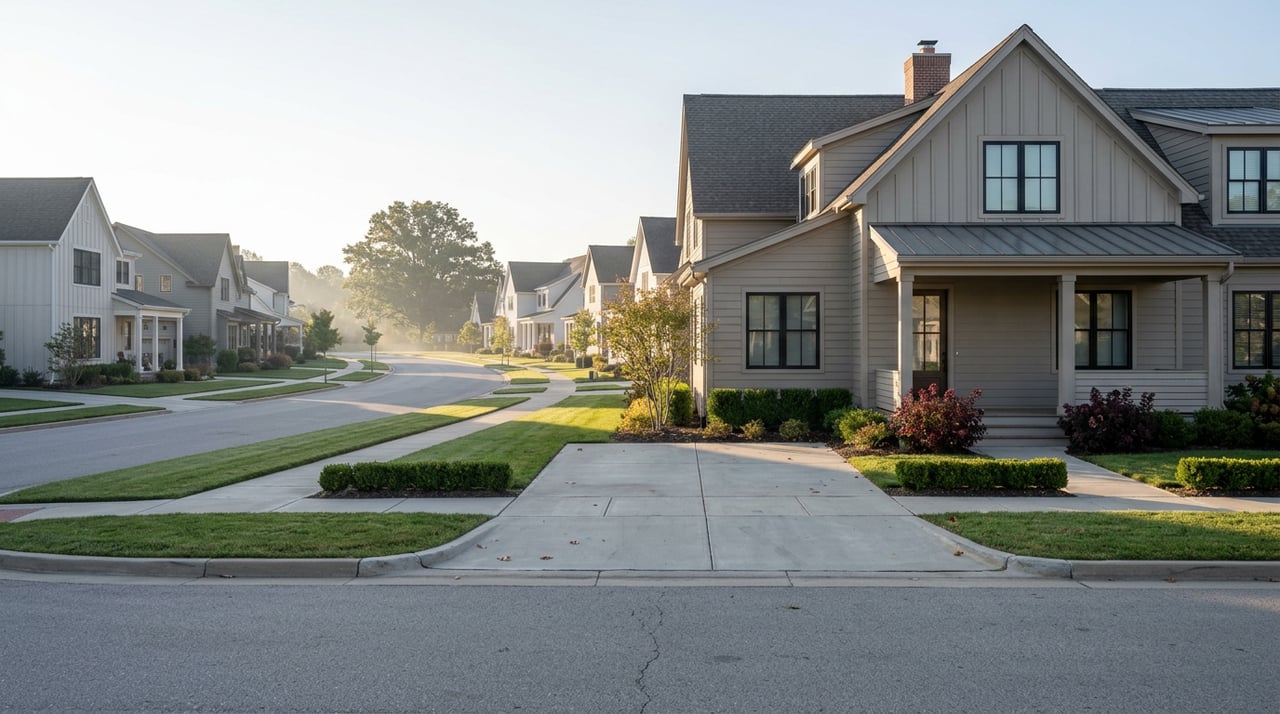
Drive Highway 19 through Waunakee this month and you'll pass framing crews, silt fence, and at least one subdivision entrance sign that wasn't there last spring. It looks like ordinary growth. A popular suburb building more houses because people want to live there. That's true, but it's only half the story, and the other half explains something buyers comparing Waunakee to Middleton or Verona right now are missing: the land pipeline that has fed this boom for three decades is closing, and the timeline for that closure is already in motion.
The Law Behind the Lots
Wisconsin caps how much revenue a municipality can raise through property taxes each year. Those levy limits can rise, but the increase is tied to new development inside the community's borders. A village that wants more money for road repair, police coverage, or fire protection without asking voters to approve a tax referendum has one reliable lever: bring in new construction. More rooftops means more assessed value, which means more room under the levy cap.
That single mechanic explains a lot about why Waunakee has spent the past twenty-five years annexing land rather than simply filling in its existing footprint. Growth isn't only a market response to buyer demand. It's also a budget strategy, one built into how Wisconsin funds local government.
Where the Land Has Actually Been Coming From
Most of Waunakee's annexable land has come from one place: the surrounding Town of Westport. Waunakee itself was carved out of Westport back in 1893, and the town has been giving up pieces of itself to its neighbors ever since. Madison and Middleton have annexed chunks from the south. Waunakee and DeForest have taken land from the north and west. As recently as 2024, the Village of DeForest sought to annex 742 acres from Westport, about 5.7 percent of the town's remaining territory, in a single request.
That arrangement made Waunakee's growth engine possible. Farmland just outside village limits could be annexed, rezoned, platted, and sold as lots, and a developer named Don Tierney built much of his business doing exactly that. Tierney has brought the regional Parade of Homes to Waunakee every year since 1995. A Parade site showcases new construction and draws buyers from across the region.
You can see that pattern playing out again this year. Victory Homes of Wisconsin broke ground in January 2026 on the inaugural Madison St. Jude Dream Home Showplace inside Tierney's Kilkenny Farms West development, a story-and-a-half home running roughly 4,700 square feet with four bedrooms, 3.5 baths, a three-car garage, and a home office, with net proceeds from its eventual sale benefiting St. Jude Children's Research Hospital. A few months later, the Madison Area Builders Association confirmed that Golden Ponds in Waunakee was scheduled to host one of the two clustered Parade of Homes sites for the June 19 to 28, 2026 event, alongside Windsor Gardens in Windsor. The construction you're seeing right now isn't a fluke of timing. It's the same growth model that's been running since the 1990s, still running.
The Door Is Closing
Here's what most people comparing Waunakee subdivisions to homes in Middleton or Verona don't know: the Town of Westport decided in September 2024 that it had had enough of being annexed piece by piece, and it filed a petition to incorporate as its own village. If that petition succeeds, Westport stops being available land for anyone to annex. Ever.
The process has moved forward steadily since then. Westport filed its formal petition with the Dane County Circuit Court in October 2024, and a judge found the following December that the town met the legal standard to proceed. In July 2025, the town filed with the state's Incorporation Review Board. Then, HNG News reported that, at a public hearing on February 11, 2026, Westport unveiled a cooperative boundary agreement negotiated with all four of its neighbors, Madison, Middleton, Waunakee, and DeForest, spelling out exactly which parcels of land transfer immediately upon incorporation, which stay in limbo until sold or for up to 20 years, and which pieces actually move back to Westport. Representatives from all four municipalities showed up to that hearing, and by most accounts it ended without serious objection.
Once that agreement is finalized through the state review process and a voter referendum, Westport becomes a village with its own zoning authority and its own comprehensive plan. It stops being a reservoir of annexable farmland for Waunakee to draw from. The land doesn't disappear, but the mechanism that has let Waunakee keep growing outward for a generation gets switched off for one of its two biggest sources.
What This Means If You're Comparing New Construction Right Now
None of this means Waunakee stops building tomorrow. Kilkenny Farms West still has lots. Golden Ponds was scheduled to host a Parade of Homes in June. The pipeline that's already annexed and platted will keep producing new-construction inventory for years.
What it does mean is that the assumption a lot of buyers carry into a Waunakee search, that there will always be another subdivision a year or two behind the one they're touring, is no longer a safe bet the way it was in 2015 or 2020. Dane County has added more than 89,000 residents since 2010 according to Census Bureau figures, and that demand hasn't slowed. If the supply of easily annexable land tightens while population growth continues, the arithmetic on new-construction pricing and lot scarcity in Waunakee starts to look different than it has for the past two decades.
For a buyer weighing new construction against an existing home in Waunakee today, that's worth factoring in. A newly platted lot in a Tierney subdivision right now is being sold against a backdrop where the next round of subdivisions, five or ten years out, may simply not exist at the pace buyers have come to expect. That's not a reason to rush a decision that doesn't fit your timeline. It is a reason to stop assuming the current pace of new-construction supply is a permanent feature of this market rather than the tail end of a specific annexation arrangement that's actively being wound down.
A Few Questions Worth Asking Directly
Does this affect home values in Waunakee today? Not directly and not immediately. Existing inventory and current subdivisions like Kilkenny Farms West aren't affected by Westport's incorporation status. The relevant question is what happens to new-construction supply five to ten years out, not what a home is worth this quarter.
Is Westport officially a village yet? As of this writing, the incorporation had cleared a circuit court finding and a negotiated boundary agreement with all four neighboring municipalities, and was continuing through the remaining state review and referendum steps required under Wisconsin law. It has not been a finished, incorporated village at any point in this timeline. Anyone quoting a specific completion date should be treated with some skepticism, since the process has already run longer than early estimates suggested.
Should this change whether I look at new construction in Waunakee versus Middleton or Verona? It shouldn't be the deciding factor on its own. It's one more piece of context for understanding why lots in Waunakee subdivisions have been so available for so long, and why that specific condition has a shelf life tied to a real legal process rather than just market cycles.
If you're weighing a new-construction lot against an existing home, or trying to figure out how Waunakee's build-out compares to what's happening in Middleton, Verona, or elsewhere in Dane County, that's exactly the kind of question worth talking through before you're standing in a model home signing a purchase agreement. Pinnacle Real Estate Group, LLC has spent years watching how these subdivisions get approved and filled, and can walk you through what a specific lot or resale option actually means for your timeline.
Let's start with a conversation.
This article is general information, not legal, tax or financial advice. Consult a qualified professional about your situation.