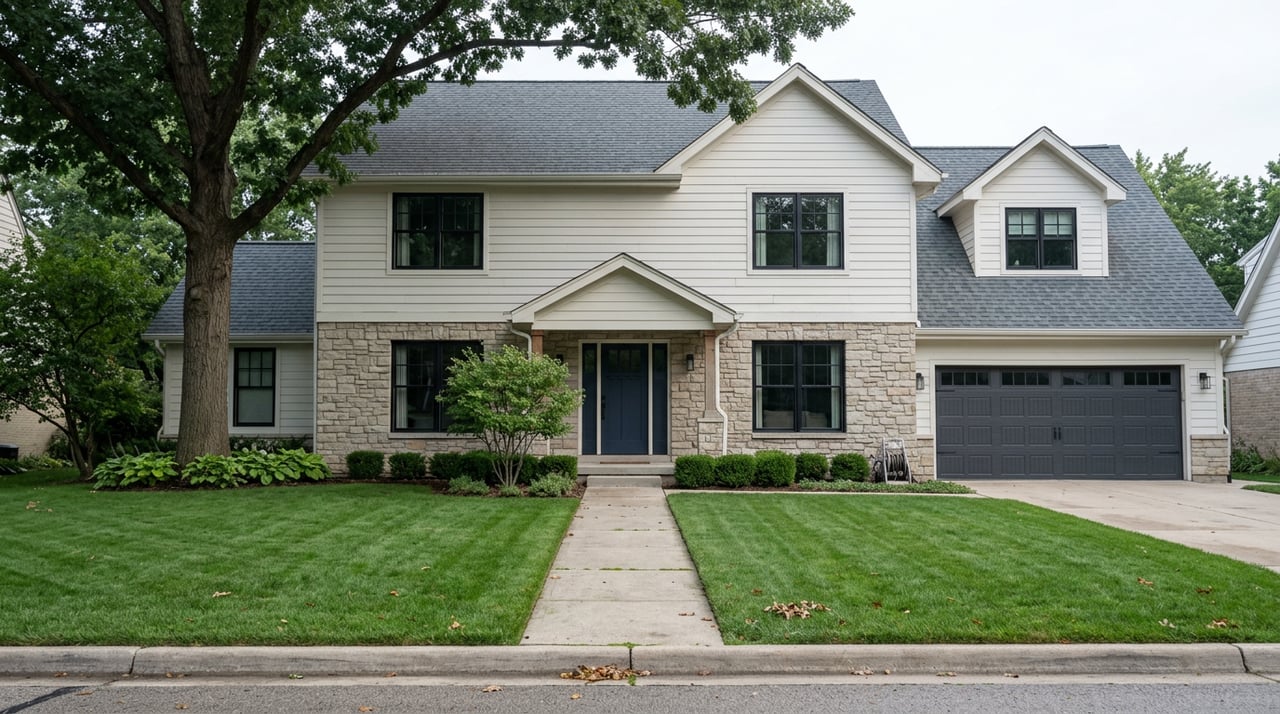
If you pulled up Madison's neighborhood data this summer, you'd see it right away. As of the August 2026 South Central Wisconsin MLS snapshot, the median list price in Near West Madison sat at $677,450. Near East Madison, just across the isthmus, listed at a median of $369,000. That's an 84 percent gap between two neighborhoods that both sit inside a three-mile ring of the Capitol, both have a walkable commercial strip full of locally owned businesses, and both get name-checked in every relocation guide written about this city.
A quick comparison can make Near West look more expensive than Near East. The numbers underneath that headline tell a different story, and it matters for anyone comparing these two neighborhoods with an actual budget in hand.
The Number Everyone Sees First
Here's how the four core Madison submarkets stacked up in that same August 2026 snapshot:
| Madison Submarket | Median List Price (Aug 2026) | Avg. Beds / Baths | Avg. Days on Market |
|---|---|---|---|
| Near West | $677,450 | 3.20 / 2.43 | 77 |
| Near East | $369,000 | 2.52 / 1.44 | 83 |
| Far West | $447,000 | 3.27 / 3.04 | 400 |
| Far East | $416,500 | 2.95 / 2.39 | 169 |
A few things jump out. Near West and Near East move at almost the same pace, 77 versus 83 days, which undercuts the idea that one side is dramatically hotter than the other. Far West's 400-day average is almost certainly skewed by a small number of stalled high-end or land listings dragging the average up rather than reflecting how a typical home there actually moves. And Far East, at 169 days, sits well above both near-side neighborhoods, meaning distance from downtown costs you time on market more than it saves you money.
But the number that matters for a buyer weighing Near East against Near West is the one missing from that table: price per square foot.
Divide By The Square Foot
Near East's August 2026 listings averaged $322.78 per square foot. That's higher than Far East's $236.59, which tells you the near-side premium is real and buyers are paying for proximity to the isthmus even on the cheaper side of town.
Now look at Near West. A Redfin snapshot from March 2026 put the median sale price per square foot there at $382, a figure pulled from actual closings rather than list prices. Compare that to Near East's $322.78 and the gap between the two neighborhoods drops from 84 percent to about 18 percent.
That's the whole thesis in one sentence. The sticker price makes Near West look like it costs almost twice as much as Near East. Once you control for square footage, it costs about a fifth more.
That comparison is useful, but it doesn't explain the full difference in list prices.
Comparing List Prices And Home Size
The per-square-foot premium is about 18 percent, compared with an 84 percent difference in median list prices. Those percentages use different measures; the figures here do not show how much of the list-price difference is attributable to home size.
Near West's average listing runs 3.20 bedrooms and 2.43 bathrooms. Near East's averages 2.52 bedrooms and 1.44 bathrooms. That's nearly a full extra bathroom and a meaningfully bigger footprint on the west side, and it lines up with what you'd expect walking either neighborhood. Near East's housing stock in areas like Schenk-Atwood dates mostly to the early 1900s, when workers built modest bungalows and two-stories close together on narrower lots near the Yahara River and Starkweather Creek. Near West's stock, closer to Vilas, Dudgeon-Monroe, and the streets radiating out from the UW Arboretum, includes more mid-century homes built with bigger footprints and, in places like Sequoya Commons near Hilldale, newer condo construction with larger unit sizes.
So the honest version of the comparison isn't "Near West is nicer, Near East is cheaper." It's closer to: Near East sells you a smaller, older home at a real but modest per-square-foot premium over the far side of town, and Near West sells you a bigger home at a per-square-foot premium that's only somewhat higher than Near East's. The neighborhood you pick determines how much house your money buys, not whether your money is worth more or less there.
Neither Side Is Coasting
Part of why the "west side is winning" story feels intuitive is that Near West's anchors are older and more familiar: Hilldale Shopping Center, Monroe Street's restaurant row, the Henry Vilas Zoo, Camp Randall within biking distance. Near East's investment has been just as real, it's just newer, so it hasn't fully sunk into people's mental map of the city yet.
A few things that changed on the near-east side this year alone:
- The Madison Public Market opened on the near east side in late July 2026, anchored by twenty-eight permanent merchants in a year-round space built around regional food, art, and culture.
- Ledger Coffee, the small-batch roaster that started at the historic Garver Feed Mill, opened a second location on Winnebago Street in the Schenk-Atwood neighborhood in April 2026.
None of that shows up in a median price calculation. All of it is part of why Atwood Avenue and Schenk's Corners, anchored by the Barrymore Theatre and the SASY Neighborhood Association, keep drawing buyers who could afford to look elsewhere and choose not to. As Isthmus documented in its reporting on the corridor's business renaissance, many of the current wave of shop and restaurant owners on Atwood are under 40, young enough that a decade ago they weren't yet in a position to start a business. That's a neighborhood building on itself, not settling for what's left over.
The Volatility Trap On The West Side
There's a second reason to be careful with any single month's median in Near West Madison specifically. That March 2026 Redfin snapshot that showed the $382 price per square foot also showed the median sale price at $580,000, down 21 percent from the year before, on a total of just 34 homes sold that month.
When a neighborhood closes 34 or 35 sales in a given month, one or two unusually expensive or unusually modest homes can swing the median by tens of thousands of dollars. Near East, with its higher sales volume of smaller starter homes, doesn't bounce around the same way month to month. If you're watching Near West's numbers and see a big swing between snapshots, that's more likely a sample-size artifact than a sign the neighborhood's value shifted overnight.
It's also worth knowing that different data providers draw slightly different lines around what counts as "Near West" or "Near East." An MLS-area boundary and a Redfin-drawn neighborhood polygon won't always include the exact same streets. That's one more reason price per square foot and bed and bath counts are more useful for comparing two homes than a single median pulled from a data source you can't fully audit.
What This Means If You're Comparing The Two
If you're actively weighing Near East against Near West Madison, a few things follow from all this:
- Ask for price per square foot on any home you're seriously considering, not just the list price, and compare it to recent closed sales in that specific neighborhood rather than the city average.
- Treat a single month's median sale price in a low-volume neighborhood like Near West with some skepticism. Look at a rolling few months if you can.
- Decide how much square footage and how many bathrooms you actually need before you decide which side of town fits your budget. A buyer who needs three bedrooms and two full baths may find that gap between the neighborhoods narrows fast once they're pricing comparable homes rather than comparing headline medians.
- Don't assume investment and neighborhood momentum only run one direction. Near East's recent openings are a sign the corridor is still adding to itself, not a discount waiting to be arbitraged away.
Frequently Asked Questions
Is Near East Madison actually the better value? It depends what you're optimizing for. Near East carries a real per-square-foot premium over Far East, so proximity to the isthmus costs something even on the "affordable" side of town. If your priority is walkability to Atwood Avenue and Schenk's Corners on a smaller home, Near East delivers that at a lower total price. If you need more bedrooms and bathrooms, the math shifts.
Why did Near West Madison's median sale price drop 21 percent in one snapshot? Most likely because the neighborhood only closes around 34 to 35 sales in a typical month. At that volume, the mix of homes that happen to sell in a given month, rather than any change in underlying value, can move the median significantly. A single high-end sale missing from one month's tally can shift the number by tens of thousands of dollars.
Should I trust price per square foot more than median price when comparing neighborhoods? For comparing two specific neighborhoods with different housing stock, yes, it's the more honest number. Median price answers "what does a typical home here cost." Price per square foot answers "what does a comparable amount of space cost here versus there," which is usually the question a buyer actually has in mind.
If you're trying to figure out what your budget actually buys on Madison's near east or near west side, that's exactly the kind of comparison worth walking through with someone who watches these numbers month to month. Pinnacle Real Estate Group, LLC works both sides of the isthmus regularly, and we're glad to pull the current comps for whichever neighborhood you're weighing. Let's start with a conversation.