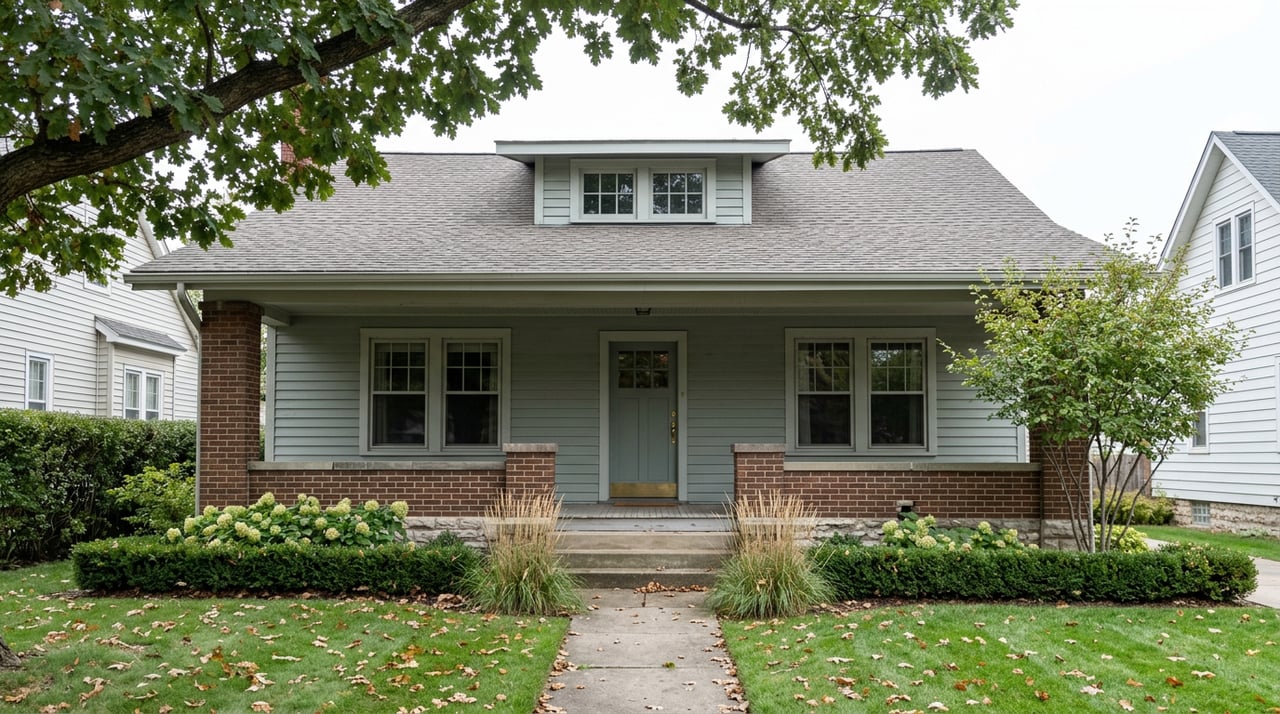
Say you've found the one. A 1920s bungalow two blocks off Monroe Street, or a turn-of-the-century foursquare near Tenney Park with the original woodwork still intact. You write a strong offer, it gets accepted, and you move into your ten-day inspection window feeling good. The inspector flags the usual things: aging shingles, a water heater near the end of its life, maybe some deferred maintenance in the basement. Nothing that changes your mind. You waive your remaining contingencies and start calling insurance agents to bind a policy before closing.
That's when the actual surprise shows up. Not from the inspector. From the underwriter.
In a lot of Madison's classic neighborhoods, the thing that stalls a closing isn't what the home inspection catches. It's what the insurance company won't cover, and it often surfaces after a buyer has already waived their right to walk away over inspection findings.
The Disclosure Form Answers a Narrower Question Than People Think
Wisconsin sellers are required to complete a Real Estate Condition Report and get it to the buyer within ten days of an accepted offer, under Wis. Stat. chapter 709. It asks direct questions about the electrical system, the foundation, and known defects. If new information comes to light before closing, the seller has to amend it.
The catch is built into the form itself. It's a disclosure of what the seller knows, not a certification from a licensed electrician. A seller who's owned a Dudgeon-Monroe bungalow for fifteen years and never had an electrical issue may genuinely have no idea that part of the house is still running on knob-and-tube. The form isn't lying. It's just answering a narrower question than the one a buyer actually needs answered, which is whether an insurance company will write a policy on the house at all.
That gap between "the seller doesn't know" and "the underwriter will decline" is where the friction lives.
Where This Shows Up Most in Madison
Madison's older neighborhoods aren't uniform, but a handful of them carry enough pre-1940s housing stock that this comes up regularly. Tenney-Lapham, along the Yahara River and Lake Mendota, is built largely around homes from the turn of the 20th century, from the era when the Fuller & Johnson Company anchored the neighborhood's east side. Dudgeon-Monroe, centered on the Monroe Street corridor between Lake Wingra and the UW Arboretum, is dense with 1920s and 1930s craftsman and bungalow construction. Vilas, Nakoma, Greenbush, and the Schenk-Atwood area carry similar vintage housing, and the city's Landmarks Commission recognizes five official historic districts across Madison, including a Marquette Bungalows district that speaks to just how much of this early-1900s bungalow stock is still standing and still selling.
| Neighborhood | Typical construction era | What buyers commonly run into |
|---|---|---|
| Tenney-Lapham | Turn of the 20th century through postwar | Original wiring and plumbing in unrenovated units |
| Dudgeon-Monroe | 1920s to 1930s, with midcentury infill | Limestone or hollow clay tile foundations under the oldest homes; concrete block foundations from the 1940s-60s now 60 to 80 years old |
| Vilas, Nakoma, Greenbush | Early 1900s through midcentury | Similar vintage housing stock, varying by block |
What's Actually Under the Plaster
The wiring gets the headlines, but the foundation story in these neighborhoods is just as uneven, and it's a good illustration of why "old house" isn't one category. In Dudgeon-Monroe specifically, the oldest craftsman homes from the 1910s through 1930s typically sit on limestone or other natural stone foundations with mortar joints, or on early poured concrete with minimal reinforcement, and sometimes on hollow clay tile or early concrete block. The midcentury homes built in the 1940s through 1960s usually have concrete block or poured concrete foundations that are now 60 to 80 years old and prone to the cracking, water infiltration, and horizontal bowing that shows up in block walls at that age. Newer infill construction in the same neighborhood is built to modern code with reinforced poured concrete and proper drainage.
Walk down a single block in Dudgeon-Monroe and you can pass through three completely different foundation risk profiles without noticing, because the exterior siding and porch style don't tell you which era's construction methods are holding the house up. That's a fact worth knowing before you fall for a listing based on curb appeal alone.
The Insurance Call That Should Happen Before You Waive Contingencies
Here's the part that actually changes how a buyer should sequence a transaction in one of these neighborhoods. Knob-and-tube wiring, common in homes built before the 1940s and 50s, has no ground wire, and that missing ground is exactly what insurers price against. Many carriers decline to write a policy on a home that still has it. Others will offer coverage but at a higher premium, and some require the wiring to be brought up to modern standards within a set window after the policy binds, sometimes as short as 30 days, or they'll cancel the policy.
None of that shows up on the Real Estate Condition Report, because it isn't a defect the seller is required to know about or disclose in insurance terms. It surfaces when a buyer's insurance agent runs the address and comes back with a decline or a quote that's double what the buyer budgeted.
The fix isn't complicated, but it does require reordering the usual playbook:
- Get a licensed electrician's report on the wiring during the same window as your home inspection, not after
- Call an insurance agent for a real quote before your inspection contingency expires, not after you've waived it
- Ask specifically whether the wiring is knob-and-tube, aluminum, or has been fully updated, since each carries a different underwriting response
- If the wiring is original, price out the rewire and the wall-patching separately. Opening and repairing plaster or drywall after an electrician runs new lines is often the cost buyers don't see coming
A rewire quote covers the electrical work. It rarely covers what happens to the walls once someone's opened them up to do it.
What This Means If You're Touring One of These Homes
None of this is a reason to avoid Tenney-Lapham, Dudgeon-Monroe, or any of Madison's older neighborhoods. These are some of the most walkable, architecturally distinct pockets in the city, close to Lake Mendota, Lake Wingra, the Arboretum, and the Henry Vilas Zoo, and that character is exactly why they hold their value. The point is timing. A buyer who orders the electrician's report and the insurance quote in parallel with the standard inspection, instead of after removing contingencies, keeps their leverage. A buyer who waives everything first and calls the insurance agent last has already given that leverage away.
If you're weighing an older Madison home against something in one of the newer-construction communities in Dane County, that sequencing difference is worth building into your timeline from the start, not discovering under pressure with a closing date already on the calendar.
A Few Questions Worth Asking Directly
Does a Wisconsin seller have to tell me if a home has knob-and-tube wiring? Only if they know about it. The Real Estate Condition Report is based on the seller's actual knowledge, so wiring that predates their ownership and has never caused a problem may not get flagged at all.
What if the disclosure form lists the electrical system as unknown or not applicable? Treat that as a signal to ask more questions, not less. It's common in homes where the seller inherited the property or never had electrical work done, and it's exactly the situation where an independent electrician's report matters most.
Can I still get standard homeowners insurance if the wiring hasn't been replaced? Sometimes, but expect a higher premium, a request for an inspection report, or a requirement to upgrade within a set window after the policy starts. Shop this before you're past your contingency deadline, not after.
If you're looking at a home in one of Madison's older neighborhoods and want a second set of eyes on the timeline before you write an offer, Pinnacle Real Estate Group can walk through the sequencing with you. Let's start with a conversation.