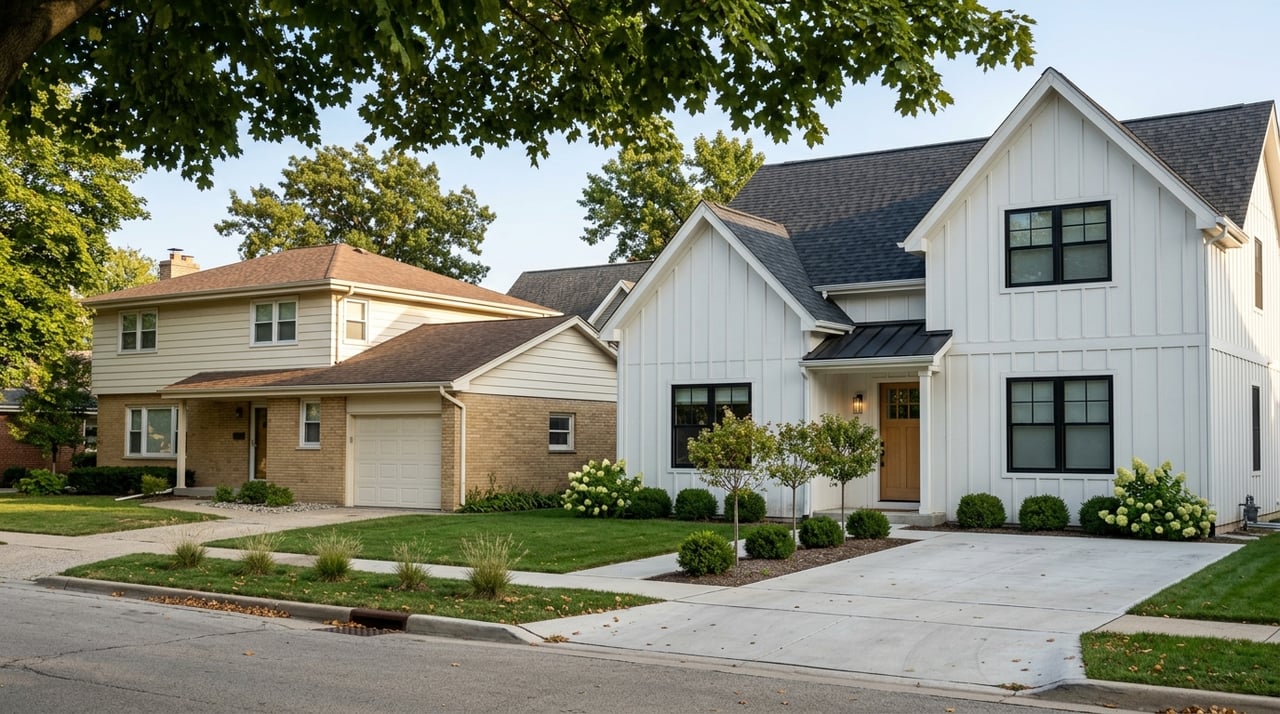
Wondering whether one part of Waunakee feels very different from another? It does, and those differences usually come down to a few practical things: when the area was platted, what kinds of homes were built there, how large the lots are, and how closely the neighborhood connects to parks and open space. If you are trying to figure out where you might feel most at home, this guide will help you compare Waunakee’s historic core, northern subdivisions, and southern growth areas in a clear, low-pressure way. Let’s dive in.
What shapes neighborhood feel in Waunakee
Waunakee is still mostly a single-family community, but it is not one-size-fits-all. According to the Village’s 2026 Housing Affordability Report, 65% of housing units are detached single-unit structures, and renter households make up 23% of all households. That means single-family homes are the dominant pattern, but there is still enough variety to create different living experiences from one area to the next.
The Village also makes it clear that subdivision patterns matter. Parcel layouts, plat age, and subdivision-specific covenants all influence how a neighborhood looks and functions day to day. In plain terms, older parts of Waunakee tend to feel more in-town and mixed, while newer areas often feel more park-centered and subdivision-oriented.
Downtown-adjacent areas feel most in-town
The oldest part of Waunakee is centered near downtown. Village archive records include the Original Plat from 1870 and several early additions, which points to the central village as the oldest built area. That history still shows up in the street pattern, housing mix, and overall feel.
This is also where housing is the most varied. The Village’s housing analysis notes that multifamily units are mostly near Main Street, some small commercial buildings have upper-level residential units, duplexes appear in downtown-adjacent areas and along busier roads, and condos are more scattered. If you want a neighborhood that feels less uniform and more mixed in age and housing type, this is where that pattern shows up most clearly.
Lot sizes here are often inferred to be smaller than in newer subdivisions, and older homes are more common. The Village has also identified the central portion of Waunakee as an area where older housing stock rehabilitation is important. That tells you this part of town can include a wider range of home ages, conditions, and update levels.
Parks reinforce the central-village feel
Downtown-adjacent living is not just about home age. It is also about access to familiar public spaces like Village Park, Reeve Park, and McWatty Park, all located near the historic business district. Those parks help give the area a more connected, everyday in-town feel.
If you picture being closer to Main Street, established blocks, and a mix of housing types, the central area is likely the closest match. It tends to feel more walkable and more tied to Waunakee’s original village pattern than the edges of town.
North and northwest areas feel classically suburban
If the downtown area feels most historic and mixed, the north and northwest sides feel more like classic subdivision Waunakee. This part of the village is strongly shaped by named subdivisions and neighborhood parks, including areas served by Westbridge Park, Meadowbrook Park, Prairie Park, Blue Ridge Park, and North Ridge Park.
That matters because park layout helps define daily life. Instead of a central downtown pattern, these neighborhoods often feel organized around internal streets, residential blocks, and nearby recreation spaces. For many buyers, that creates a more traditional suburban rhythm.
The park system supports that impression. Westbridge Park includes a playground, shelter, tennis courts, and restrooms. Meadowbrook Park includes baseball fields, a playground, tennis, and a scenic walk, while North Ridge Park connects to Scenic Valley Park through an open-space trail corridor.
Housing tends to reflect subdivision eras
The Village’s 2018 zoning and housing review offers an important clue here. It says some of the highest single-family home values were found in the northwest and south ends of town, where newer subdivisions were built with larger homes on larger lots. That suggests parts of the northwest side may appeal to buyers looking for a more established suburban setting with larger-lot patterns than some of the newest development phases.
At the same time, not every newer neighborhood follows the same formula. The same Village analysis says that home construction since the Great Recession has shifted toward more compact homes on smaller lots. So even within the broader north side and northwest areas, you may notice differences between earlier suburban subdivisions and later phases of development.
South and southeast areas feel newer and greener
The south and southeast sides of Waunakee have a different feel again. These areas stand out for their combination of newer subdivision growth, strong park access, and adjacency to larger open-space areas. If you want a neighborhood that feels more edge-of-village and recreation-oriented, this part of town is worth a close look.
Savannah Park serves the Savannah Village Subdivision in the southeast corner, Hanover Park serves the Montondon Addition to Savannah Village, and Tierney Park serves the Southbridge Neighborhood. These are not small details. In Waunakee, park placement often helps explain how a neighborhood functions and why it feels the way it does.
Tierney Park is especially notable because it connects to extensive public open space and conservancy lands stretching south toward Governor Nelson State Park. The Village also notes that the Southbridge area is bordered by Bolz Conservancy. That creates a stronger green-buffer effect than you typically get in the central village core.
Recreation plays a bigger role here
The south and southeast side also has a more active recreation profile. Savannah Park includes ballfields, basketball, roller hockey, ice skating, and walking trails. Tierney Park includes soccer, football, baseball-softball, tennis, and a shelter.
For some buyers, that recreation network becomes part of the home search decision. If you want nearby fields, trails, and open space as part of your routine, the southern side of Waunakee may feel more aligned with that lifestyle than older in-town blocks.
Home patterns can vary by development phase
The same Village housing analysis that highlights higher single-family values in the south also notes that many southern neighborhoods were developed with larger homes on larger lots. But that is only part of the story. Current Village policy also emphasizes smaller lots in Traditional Neighborhood Developments and more integrated housing types.
So if you are looking at the south or southeast side, it helps to think in phases rather than broad labels. One subdivision may feel more spacious and earlier-generation suburban, while a newer phase may feel more compact and planned for a wider housing mix.
Waunakee is not only single-family
It is easy to think of Waunakee as entirely detached homes, but the Village’s own reports show a more layered picture. Multifamily units are concentrated mostly near Main Street, and other housing types are mixed in around the village. The 2026 Housing Affordability Report also highlights Woodland Crest, where 75 market-rate one- and two-bedroom apartments opened in 2025.
That does not change the fact that Waunakee is still predominantly a detached-single-family market. It does mean, however, that some parts of the village offer more housing variety than others. If you are open to condos, apartments, or mixed-housing areas, your best fit may not look the same as someone focused only on larger-lot single-family subdivisions.
Commute convenience is mostly road-based
If you commute toward Madison, neighborhood feel is only part of the equation. In Waunakee, commute patterns are mostly shaped by road access rather than transit options. Official Village materials identify Main Street as WIS 19 and WIS 113, making that central corridor the key route system for getting into Madison.
Village planning documents also note that Waunakee is approximately 5 miles north of Madison. That close proximity helps, but ease of travel often depends more on how directly your neighborhood connects to Main Street, Highway 19, or Highway 113 than on the neighborhood name itself.
For biking, the Village identifies Woodland Drive as a primary bicycle route connecting into County Highway M, with connections onward to Highway 113 and Madison. Highway 19 is also part of the primary bicycle network. Still, for most households, daily commuting remains mainly car-based.
The Village’s transportation page does include senior-focused ride programs, but Waunakee is not set up as a general-purpose transit suburb. For most buyers, that means road layout and route access matter more than bus access when comparing one area to another.
How to choose the right Waunakee fit
When you strip away the neighborhood names, Waunakee’s differences become easier to understand. The historic core offers the most mixed-age, mixed-use, in-town feel. The north and northwest sides offer the most conventional suburban subdivision feel with strong park access, while the south and southeast sides tend to feel newer, more recreation-oriented, and more connected to open space.
A simple way to narrow your search is to ask yourself a few practical questions:
- Do you want an in-town setting or a subdivision setting?
- Do you prefer older homes and mixed housing types, or newer development patterns?
- Is park access a nice bonus or a daily priority?
- Would you rather be near the central village pattern or closer to edge-of-village open space?
- How important is quick access to Main Street, WIS 19, or WIS 113 for your routine?
If you are planning a move in Waunakee, the best choice usually comes down to matching your daily routine with the right neighborhood pattern, not chasing a one-size-fits-all label. If you want help comparing areas, home styles, or new construction options in Waunakee and the rest of Dane County, Pinnacle Real Estate Group, LLC is here to help with clear, low-pressure guidance.
FAQs
How do downtown Waunakee neighborhoods feel compared with newer areas?
- Downtown-adjacent Waunakee neighborhoods generally feel more in-town, with older plats, a more mixed housing pattern, and close access to parks near the historic business district.
What do north and northwest Waunakee neighborhoods feel like?
- North and northwest Waunakee neighborhoods usually feel more like classic suburban subdivisions, with neighborhood parks, internal residential streets, and a quieter setting than the central village blocks.
What stands out about south and southeast Waunakee neighborhoods?
- South and southeast Waunakee neighborhoods tend to feel newer and more recreation-oriented, with strong park amenities and access to open space and conservancy areas.
Are all Waunakee neighborhoods mostly single-family homes?
- Waunakee is predominantly single-family overall, but housing types vary by area, with more multifamily and mixed-use housing patterns found near Main Street and some newer apartment development in the village.
What matters most for commuting from Waunakee to Madison?
- For most Waunakee residents, commute convenience depends mainly on road access to Main Street, WIS 19, and WIS 113, since the village is largely car-based rather than general-purpose transit-based.